

Research
Medical AI and Digital Health Research
The Department of Big Data Medical Science and Healthcare Digital Transformation, led by Professor Yasushi Okuno, harnesses AI, data science, and omics analyses to discover disease biomarkers, identify therapeutic targets, predict disease onset, and implement preventive healthcare.
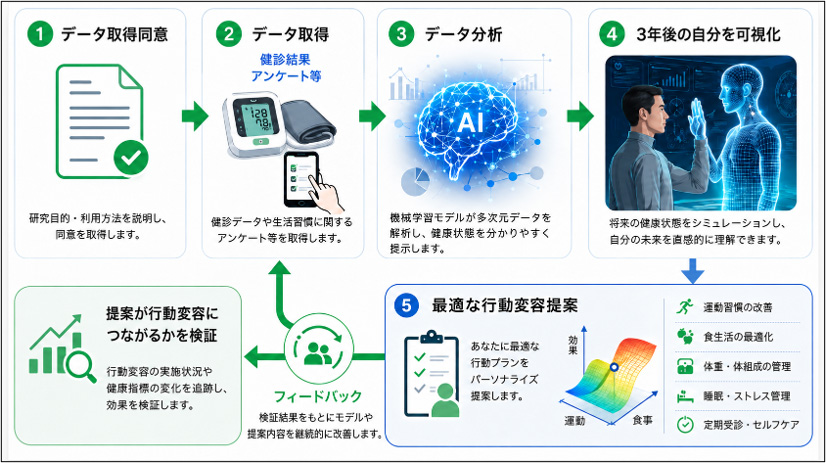
We are developing an AI-powered application for disease prevention. For conditions including diabetes, hypertension, dyslipidemia, metabolic syndrome, and chronic kidney disease, the system visualizes each individual’s projected health status three years into the future and supports health guidance tailored to their personal health priorities and behavioral characteristics (Figure 1). We are conducting a specified clinical research study in collaboration with Hankyu Hanshin Holdings, with the goal of bringing personalized preventive healthcare into real-world practice (jRCTs052230135).
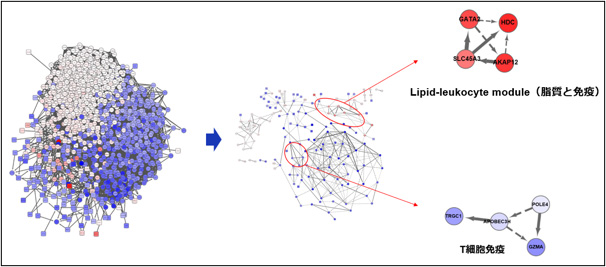
In moyamoya disease, we focus on risk factors that cannot be explained by RNF213 variants alone and conduct integrative analyses of clinical information and omics data. Our findings suggest that upregulation of a lipid?leukocyte module containing GATA2 may be associated with the risk of disease onset (Figure 2). By linking genetic predisposition with inflammation, lipid metabolism, and immune responses, we aim to develop a new understanding of the pathophysiology of moyamoya disease.
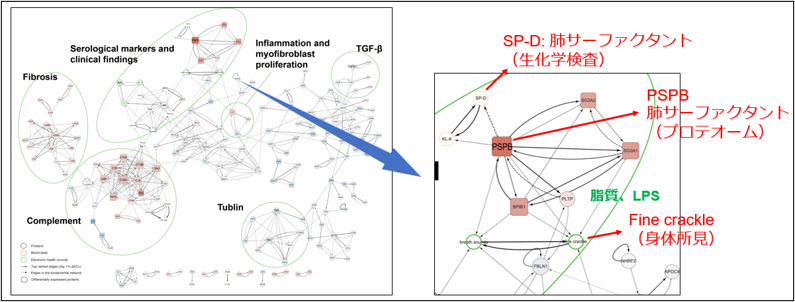
In idiopathic pulmonary fibrosis, we are conducting collaborative research with the National Institutes of Biomedical Innovation, Health and Nutrition. Through network analyses integrating clinical symptoms, blood test results, and proteomic data, we have identified novel biomarker candidates. By combining clinical findings with molecular networks, we aim to improve the explainability of disease mechanisms and identify potential targets for drug development (Figure 3).
Intractable Vascular Disease and iPS Cell Research
Moyamoya disease is a disorder in which the major arteries supplying the brain gradually narrow, potentially causing ischemic stroke or intracranial hemorrhage. To understand why the disease develops, we study genetic factors, immune responses, the gut microbiome, and vascular cell function. Through family-based analyses of moyamoya disease, we identified RNF213 p.R4810K as a major genetic risk variant. This variant has been associated not only with moyamoya disease but also with unilateral moyamoya disease, moyamoya-like cerebrovascular disorders, and systemic vascular diseases such as coronary artery disease, pulmonary hypertension, and renal artery stenosis. We have proposed the concept of RNF213-associated vasculopathy to encompass this broader spectrum of vascular disorders.
We have also shown that cerebral artery stenosis detected before a diagnosis of moyamoya disease may progress over time to definite moyamoya disease, and that RNF213 variants may contribute to this risk of progression. These findings suggest the existence of a continuum of vascular conditions related to moyamoya disease, which may be broadly understood as a “moyamoya disease spectrum.” In addition, studies involving patients’ relatives and the general population suggest that vascular changes may be detectable at an early stage, even before symptoms appear.
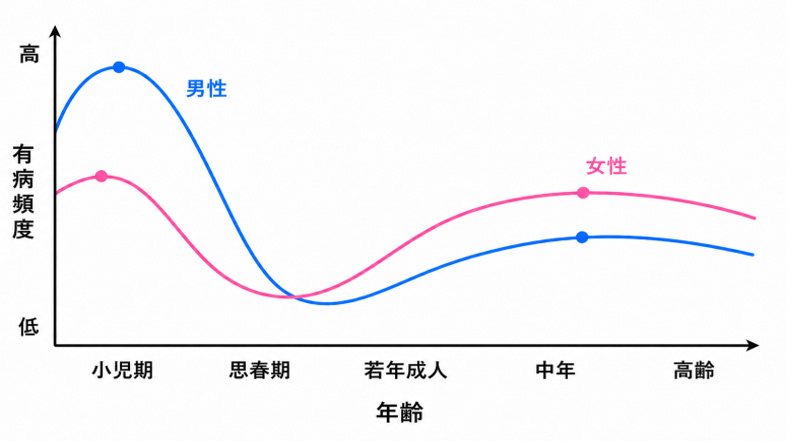
However, many people who carry an RNF213 variant never develop moyamoya disease. We therefore focus on the gut microbiome, immune responses, and lipid metabolism as potential factors that influence disease onset. In particular, we have found that a group of lipid- and leukocyte-related molecules containing GATA2 may be associated with disease risk and severity. GATA2 is known to be involved in type 2 inflammation, and elevated GATA2 expression has also been associated with eosinophilic asthma. Moreover, asthma and moyamoya disease show similar age- and sex-related patterns of onset, with both occurring frequently in childhood and showing a female predominance in adulthood (Figure).
These findings suggest that immune and inflammatory responses, including type 2 inflammation, may contribute to the onset and progression of moyamoya disease in addition to RNF213 variants. We are also using patient-derived iPS cells and genome-editing technologies to develop vascular cell models and three-dimensional vascular organoids that reproduce disease mechanisms in the laboratory. By elucidating the function of RNF213, we aim to advance the early diagnosis and prediction of disease onset and ultimately develop new treatments for moyamoya disease.
Cutting-Edge Brain Tumor Treatment and Clinical Research
Brain tumors, particularly gliomas, frequently recur despite multimodal treatment combining surgery, radiotherapy, and pharmacotherapy, and they remain difficult to treat. To understand why brain tumors develop, progress, and become resistant to treatment, we investigate immune responses, the tumor microenvironment, cellular senescence, and metabolic stress.
We have contributed to the development of immunogene therapy for glioma and investigated novel therapeutic strategies that enhance antitumor immune responses. We currently study how brain tumors adapt to stressful conditions such as hypoxia and ischemia from the perspectives of immunity, inflammation, cellular senescence, and metabolic changes, with the aim of elucidating the mechanisms underlying recurrence and treatment resistance.
We also place a strong emphasis on pediatric brain tumors. Using medulloblastoma and brainstem glioma as major disease models, we investigate their molecular pathogenesis and develop novel treatments. Patient-derived specimens and experimental models are used to identify potential therapeutic targets and characterize the immune microenvironment.
To translate discoveries from basic research into clinical practice, we have established a database integrating clinical information, imaging data, and surgical specimens from patients with brain tumors. We use this resource to identify biomarkers and investigate disease mechanisms. Through multicenter clinical trials, we also evaluate the efficacy and safety of new treatments and seek to bring discoveries from basic research into patient care. Through these efforts, we aim to clarify the mechanisms underlying brain tumor recurrence and treatment resistance, develop new therapeutic approaches?including immunotherapy, gene therapy, and molecularly targeted therapy?and realize personalized medicine tailored to each patient.